AI Forex Signals vs Human Analysis: Accuracy, Bias and a Fair Comparison
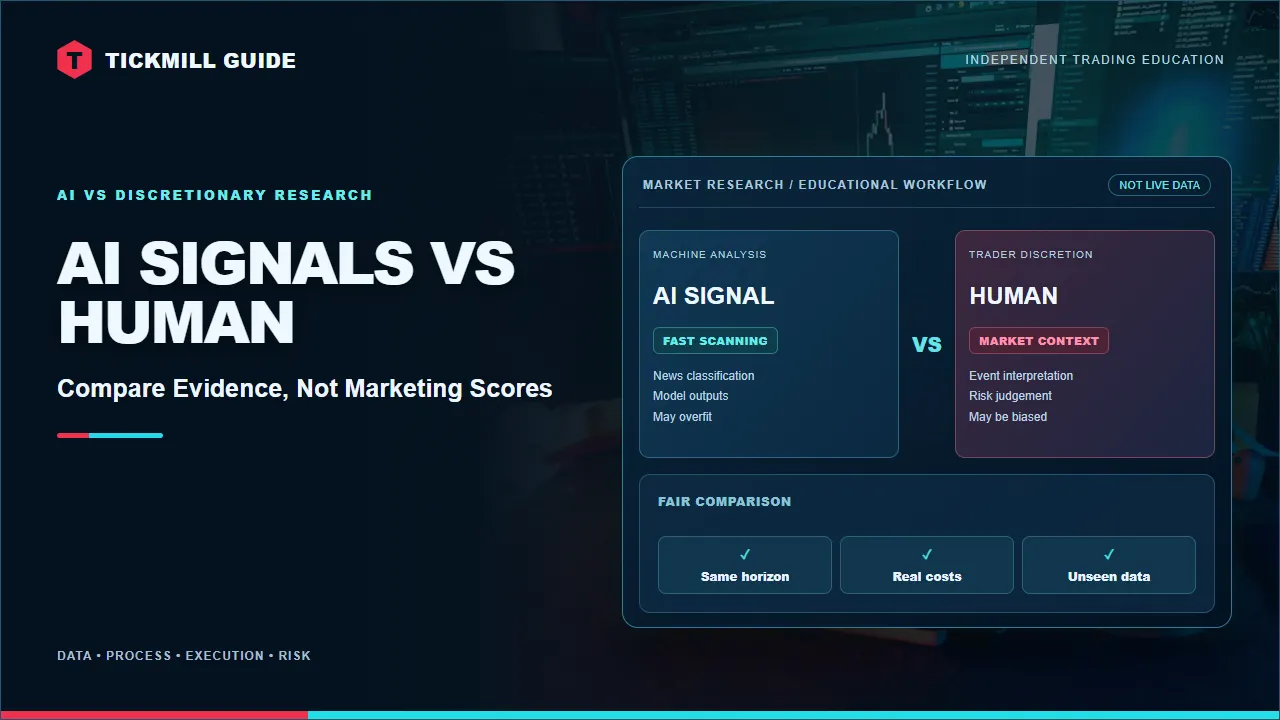
Editorial check: October 2026 · Independent education · Trading terms vary by legal entity and country.
“Which is better—AI signals or human analysis?” is a tempting question because it seems to promise one winning method. In reality, the answer depends on what both approaches are being asked to do. A sentiment model can screen thousands of headlines more quickly than one trader. A discretionary trader may recognise that a new central-bank statement contradicts the usual pattern. Both can misinterpret a market that changes regime unexpectedly.
The fair comparison is not a screenshot of an AI confidence score beside a trader's hand-drawn chart. It is a repeatable study with the same market, time window, execution assumptions and risk budget. This guide offers a practical framework suitable for researching Tickmill trading tools and independent signals, without claiming that either humans or AI reliably forecasts profit.
Understand what counts as a signal
A signal can be a directional forecast, a proposed setup with entry and stop, a market sentiment classification or simply an alert that conditions changed. These are not equivalent. A bullish sentiment gauge can be correct about news tone while a long trade loses money because price had already incorporated that information. A discretionary trend analysis can identify support accurately but still produce a poor trade if spread and reward-to-risk are unfavourable.
Before comparing providers, define the exact output: symbol, timestamp, horizon, allowed entry type, invalidation and order expiry. Without these details, a signal can be celebrated retrospectively whenever the market touches a favourable price, while failures quietly disappear from the record.
Tickmill Acuity, Signal Centre and a human chart review
Tickmill's Acuity Trading offers sentiment and event analysis. Signal Centre presents general structured market research for supported MT4/MT5 environments. Neither should be treated as a claim of personalised guidance or guaranteed accuracy. A human analyst may use these tools as inputs while evaluating price, news context and risk independently.
Note that multiple indicators drawing on the same underlying news feed are not necessarily independent confirmations. A headline-sentiment panel and a research briefing may react to the same event. Counting them as two votes can create false confidence even when the underlying observation is effectively one.
Accuracy needs a definition—and profit needs more than accuracy
Consider a model that predicts whether EUR/USD will close higher over the next hour. A 60% hit rate can sound excellent. But if the average win is 0.4R and the average loss is 1R, the expected gross outcome of ten equally sized trades would still be negative: six wins contribute +2.4R while four losses contribute −4R. This is a hypothetical arithmetic exercise, not data from Tickmill or an AI vendor.
Profitability needs the size of wins and losses, transaction costs, trade frequency, execution quality, correlation and tail risks. A forecast can outperform random direction while producing poor net trading results. Conversely, a low hit-rate strategy can make money in some circumstances if profitable trades are much larger than losses—but again this must be demonstrated with honest data.
| Metric | Why record it | Common mistake |
|---|---|---|
| Directional hit rate | How often a defined forecast was correct | Ignoring the forecast horizon |
| Net R per trade | Outcome after consistent risk sizing | Reporting hit rate without payoff size |
| Max drawdown | Severity of peak-to-trough declines | Publishing only annual return |
| Execution cost | Spread, commission, slippage, swap | Assuming every entry fills at the mid-price |
| Out-of-sample stability | Performance beyond tuning data | Retesting until a favourable period appears |
A human analyst has biases too
A trader can anchor on yesterday's high, seek evidence for a preferred currency direction or double down after losses. These are behavioural problems, not proof that an AI model is superior. Human analysis has a different advantage: an experienced reader can sometimes identify a broken assumption or an unusual event that a narrowly trained model mishandles.
The solution is not to romanticise human intuition. Write down analysis before observing the result, keep the original forecast, and apply the same evaluation rules to both human and algorithmic decisions. If you let an analyst revise the entry after the trade, the comparison becomes meaningless.
How to run a fair test without risking live capital
- Select one instrument and a fixed testing horizon—for example, hourly EUR/USD signals for a defined date range.
- Record every signal at the time issued, including no-trade decisions, expiry and any later edits.
- Choose a realistic order rule, position size, cost model and stop methodology before starting.
- Apply the same slippage and commission assumptions to both approaches.
- Evaluate on an untouched forward period rather than selecting only examples that looked good afterward.
- Report both the distribution of outcomes and periods when each approach failed.
Begin in a demo or research-only spreadsheet. MetaTrader's testing environment can help validate rule-based implementations, but a human judgement process requires equally careful timestamped records. Our Tickmill demo account guide explains how to keep virtual testing realistic.
Build a single scorecard
A score that lacks a documented dataset, horizon and fill assumptions cannot prove a superior method.
Combining model output with human veto rules
Some traders use AI only to shortlist instruments or flag unusual sentiment, then use a written checklist to accept or reject the setup. This can save attention without delegating actual execution. A reasonable veto might be “no new trades during my predefined news window” or “no entry if spread exceeds my tested limit,” rather than a subjective excuse added after a losing trade.
Record whether the veto improved results on new observations. It is easy to create extra layers that make old backtests prettier but reduce the number of useful trading opportunities. If a model and human disagree, documenting the disagreement may be more informative than forcing a decision.
When neither AI nor humans should trade
During a platform outage, abnormal spread, unverified instrument specification or market gap, the best response may be to suspend new orders. No apparent pattern is valuable when order execution cannot be managed safely. Our slippage and stop-loss guide describes why fill quality changes in exactly those circumstances.
Before scaling up any apparent edge, read your broker's real account costs and legal entity terms. The trading-cost article is useful for comparing a theoretically accurate signal with its realistic net return.
Frequently asked questions
Is a claimed 90% AI signal win rate credible?
It cannot be assessed without timestamped signals, a defined horizon, full wins and losses, costs, sample size and independent validation. Treat unsupported scores as marketing.
Does two bullish AI tools equal two independent forecasts?
Not necessarily. If they use overlapping headlines, price data or methodology, their errors can be correlated.
Can discretionary judgement improve automated trading?
Sometimes a documented, tested human veto can be useful, but ad hoc interventions also introduce bias. Evaluate both outcomes fairly.
References and methodology
Background sources: Tickmill Acuity Trading, Tickmill Signal Centre, and MetaTrader 5 forward-optimization framework. Reviewed October 2026. There are no real AI signal accuracy claims in the illustrative examples above.
Check the details before you trade
Confirm the broker entity, account eligibility, latest fees, platform options and risk documents with Tickmill. We may earn a commission from a qualifying referral. This is not personalised investment advice.
Visit Tickmill through our affiliate link →Important: Leveraged trading can cause significant losses and is not appropriate for everyone. This independent site is not operated or endorsed by Tickmill. Read the Affiliate Disclosure and Risk Disclosure.


Comments
Have a question about this guide? Join the conversation below.
Post a Comment