AI Forex Trading for Beginners in 2026: What AI Can and Cannot Do
Editorial check: October 2026 · Independent education · Trading terms vary by legal entity and country.
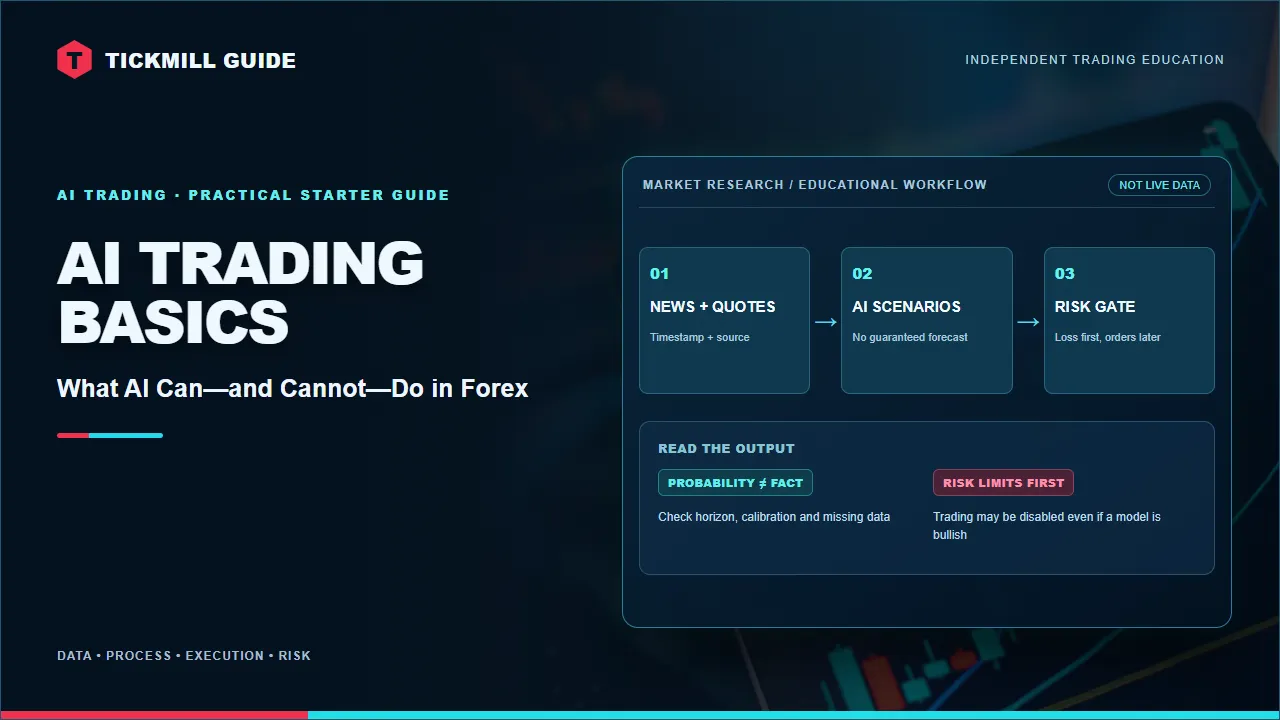
Artificial intelligence can summarise a morning's market news in seconds and help a trader organise ideas that would otherwise be scattered across charts, calendars and notes. What it cannot do is remove uncertainty from the next EUR/USD candle. Much of the appeal of “AI forex trading” comes from treating these two different jobs—organising information and making profitable decisions—as though they were the same. They are not.
This guide explains where AI can fit into a practical trading process, what a broker tool actually does, and how a beginner can experiment without confusing a polished prediction with verified evidence. It is independent editorial content, not a Tickmill feature announcement or a promise of returns.
First, separate four technologies often called “AI trading”
Generative AI can write explanations, check a trading journal for missing fields and help compare alternative market scenarios. Sentiment analysis classifies text and news, sometimes into bullish, neutral or bearish categories. Rule-based automation follows predefined instructions, such as entering after a price breakout and applying a stop. Machine-learning prediction estimates patterns from historical data. These categories can overlap, but each has different input requirements, validation problems and execution risks.
| Technology | Useful job | Important limitation |
|---|---|---|
| ChatGPT or another assistant | Summarise research and structure a trading plan | Can generate plausible but incorrect figures or references |
| News sentiment model | Highlight changes in tone or event risk | Sentiment is not a guaranteed direction or price target |
| MetaTrader Expert Advisor | Execute explicit rules automatically | Code or connection errors can create unintended orders |
| Statistical/ML model | Estimate relationships within data | Overfitting and changing markets can destroy past patterns |
For a new trader, separating these categories prevents a common buying mistake: paying for a so-called “AI bot” without knowing whether it is a basic indicator, a pre-programmed Expert Advisor or a predictive model that has never been evaluated on unseen data.
What Tickmill offers: Acuity and Signal Centre
Tickmill describes Acuity Trading as an AI-assisted news and sentiment tool for MetaTrader. Its separate Signal Centre offers general structured market research and trading ideas, with installation for MT4 and MT5 where available. These tools may help a reader organise data or compare scenarios. The underlying provider disclosures say the research is non-personalised and does not itself execute client trades.
That is a meaningful distinction. You cannot infer that Tickmill's sentiment dashboard is a guaranteed auto-trading engine simply because an installer appears under Expert Advisors in MetaTrader. Product eligibility depends on your country and legal entity. Our Acuity and Signal Centre guide covers the actual workflow and its limitations.
A five-stage AI-assisted research workflow
- Choose one instrument and horizon: for example, analyse EUR/USD around a scheduled event instead of asking an assistant to scan every market for an instant winner.
- Collect dated primary inputs: official calendar time, current bid/ask, broker specifications and the text of the actual news release. A model without reliable live data cannot know today's price.
- Ask for scenarios rather than a single prediction: what might invalidate a bullish narrative, what would a bearish surprise look like, and what information is missing?
- Check with independent evidence: compare claims against the original release, actual quotes and observable market structure before treating a scenario as useful.
- Apply risk rules and record the outcome: define maximum permitted loss, order type, invalidation and whether the trade is allowed at all. The correct decision may be to do nothing.
This workflow does not require an AI-generated buy or sell signal. The immediate benefit is often a clearer reason to reject a weak setup. The information layer should remain separate from the actual trading decision and from your broker account credentials.
Why plausible forecasts can be dangerously convincing
Generative models excel at producing coherent sentences, charts and explanations. That strength is not evidence that a suggested probability or price level was calculated from reliable real-time market data. A model can invent a recent news release, confuse two instruments, misread a contract specification or present a hypothetical backtest as if it actually ran. These are examples of why manual validation is essential rather than rare edge cases to ignore.
Suppose an AI assistant says, “EUR/USD has a 78% chance of rising.” Before acting, ask what “rising” means, which data set was used, over what future period, whether spread and execution costs were included and how calibration was tested out of sample. Without answers, the percentage is decoration, not a measured forecast.
The evidence filter for an AI claim
Every apparent trading edge needs these three checks. No single AI confidence score replaces them.
Backtesting is not the same as selecting a winning screenshot
Testing AI filters on past data can be useful, but the model must not have access to future data during a historical decision. Traders sometimes refine dozens of conditions until the result looks beautiful, then describe it as a stable strategy. That is overfitting. A fair design leaves a later period untouched for validation and includes realistic spread, commissions, swaps and slippage assumptions.
MetaTrader 5 provides a Strategy Tester with a forward-period option specifically intended to help examine over-optimisation. Even a promising out-of-sample result is not a guarantee of what will happen with a live account. Read our planned AI backtesting and walk-forward guide for a more complete methodology.
The privacy rule beginners should never skip
Do not paste Client Area passwords, trading-account login credentials, bank statements, payment-card data or unredacted identity documents into public AI prompts or unknown strategy generators. When using an assistant for a journal, replace account identifiers with neutral labels, omit unnecessary personal details and avoid uploading files you are not authorised to share.
For an educational exercise, a synthetic journal containing instrument, timeframe, hypothetical entry, exit, risk and outcome is sufficient. You can learn how to classify trading mistakes without asking an AI service to access your brokerage account.
Should a beginner automate live orders immediately?
No, not merely because the tool claims to use AI. First demonstrate that you can explain the strategy rule, estimate trading costs, use a demo terminal and recover from a failed internet connection. Then test how the strategy behaves under spreads wider than normal and positions moving against you. Tickmill's VPS materials show how a remote server may help keep an EA connected; that is operational infrastructure, not a reason to increase leverage.
If you eventually automate, retain explicit exposure limits, account-level monitoring and a procedure for stopping new orders. Our VPS and EA setup guide is a practical companion. None of these tools turns leveraged CFDs into low-risk investments.
Frequently asked questions
Can AI predict forex profit consistently?
No AI tool can credibly guarantee profits or perfect directional forecasts. A model's usefulness must be measured against realistic data, transaction costs and previously unseen conditions.
Does an EA have to use artificial intelligence?
No. An Expert Advisor can be entirely rule-based. Automated execution and predictive machine learning are different concepts.
Are Tickmill's Acuity tools personalised financial advice?
The provider describes its content as general analysis rather than personalised advice. Evaluate eligibility and disclosures for your own legal entity.
Primary sources and further reading
Official reference material: Tickmill Acuity Trading, Signal Centre, and MetaTrader 5 Strategy Optimization documentation. Editorial review: October 2026. Market data and eligibility change; verify with the relevant official provider.
Check the details before you trade
Confirm the broker entity, account eligibility, latest fees, platform options and risk documents with Tickmill. We may earn a commission from a qualifying referral. This is not personalised investment advice.
Visit Tickmill through our affiliate link →Important: Leveraged trading can cause significant losses and is not appropriate for everyone. This independent site is not operated or endorsed by Tickmill. Read the Affiliate Disclosure and Risk Disclosure.


Comments
Have a question about this guide? Join the conversation below.
Post a Comment