Is Tickmill Safe? Segregated Funds, Negative Balance Protection and Entity Differences
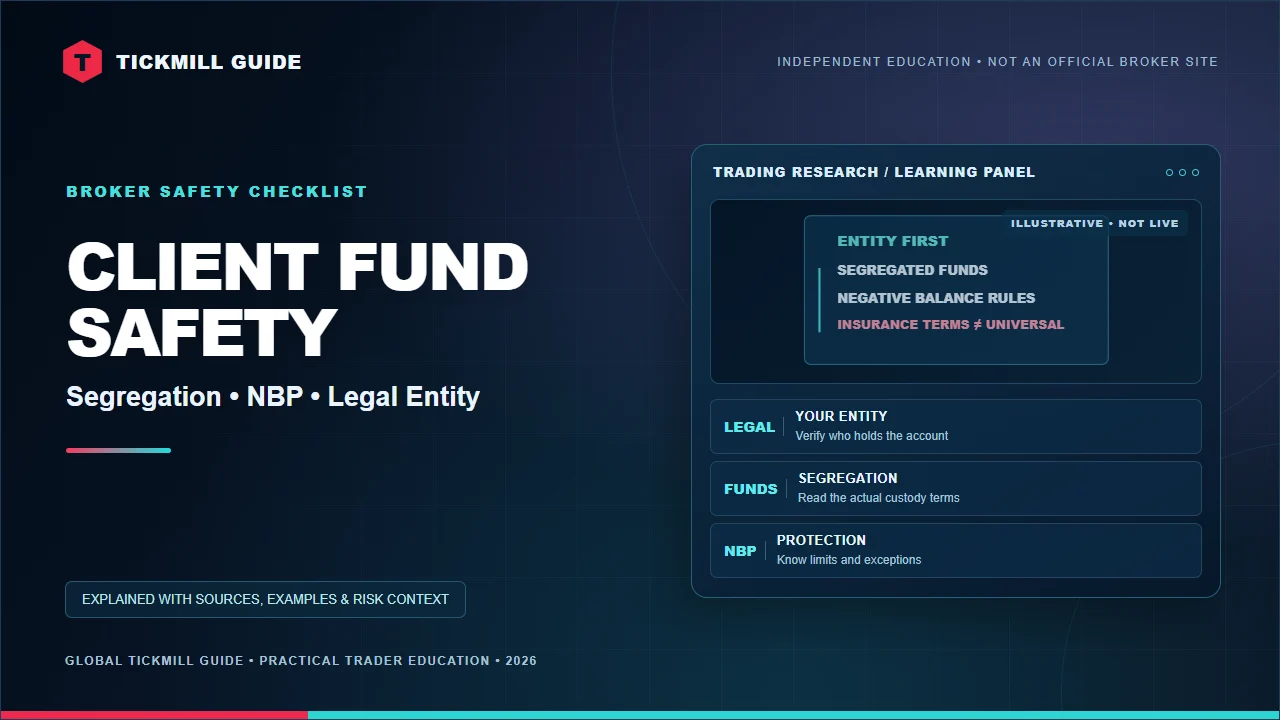
Editorial check: October 2026 · Independent education · Trading terms vary by legal entity and country.
When traders ask whether Tickmill is safe, they often receive a list of licences and awards. Neither tells the whole story. The key questions are which legal company will hold your account, how client money is treated, which protections apply to your product and client category, and what happens if markets gap against your position. Tickmill operates through more than one regulated company, and legal rights can differ even when the websites carry the same brand.
This guide turns marketing terms such as “segregated accounts,” “negative balance protection” and “funds insurance” into practical due-diligence questions. It does not guarantee a broker's future solvency or recommend that a particular reader deposit money. Always read the exact client agreement and the regulator's current register relevant to your place of residence.
First identify the company in your client agreement
Tickmill's group regulation page identifies different regulated businesses, including UK, European, Seychelles and South African entities. The presence of a group licence does not mean a customer contracting with one entity automatically receives the protections of another. Before funding, look for the legal company name on the account-opening flow, agreements, risk disclosures and payment instructions.
For example, a British regulator's register entry for the UK company is useful evidence about that company; it is not a substitute for checking whether your specific account is actually held there. The same principle applies to EU and offshore licensing. The details should be internally consistent, and you should be cautious if someone demands payment into an unrelated private account.
| Check | What it tells you | What it does not prove |
|---|---|---|
| Legal entity and licence | Which company and supervisor apply | That the group has identical protections everywhere |
| Client-money segregation | How broker money and customer funds are separated | Guaranteed access to every deposit at every moment |
| Negative balance protection | How certain account deficits are handled | Protection from losing the deposited balance |
| Insurance or compensation | Potential claim mechanisms, subject to eligibility | An unconditional personal guarantee for all traders |
What are segregated client funds?
Tickmill states that client funds are held in bank accounts separate from its operational money. This is a meaningful control: it aims to prevent routine company expenditure from being mixed with customer deposits. Nevertheless, segregation is not a trading-loss guarantee, and a client-money shortfall or insolvency could still involve a legal process rather than instant repayment.
Read how the legal entity treats client money, the role of third-party banking partners, and any exclusions associated with professional classifications, instruments or local law. Ask what documentation would be required to establish your entitlement if the firm or a banking provider failed.
Negative balance protection: what it means
Tickmill's English-language FAQ describes negative balance protection and gives a gap-risk example. Suppose a trader's account contains $200 and a leveraged position loses $300 during a price gap. Without any applicable protection, the account's arithmetic result would be negative $100. Under the relevant protection, the broker describes resetting qualifying negative equity to zero, rather than requiring the client to settle that deficit.
A simplified weekend-gap example
Protection rules and exceptions must be checked in the actual client agreement. The deposited $200 can still be lost.
The FAQ also says Tickmill may withhold this protection when a deficit results from fraudulent activity or market abuse. Conditions and classifications therefore matter. Do not build a strategy around the assumption that a broker must absorb repeated intentional deficits or that high leverage has no consequence.
Does negative balance protection make leverage safe?
No. Protection against certain debts is different from protecting your capital from trading losses. A position can lose the entire funded balance rapidly, close at a worse price than requested and leave you unable to participate in subsequent opportunities. Risk also includes platform access, your own errors, spread widening and the psychological temptation to increase size.
Tickmill itself warns that using maximum available leverage increases the chance of triggering a negative balance before the mechanism is applied. Traders should size positions for the loss they can afford, rather than simply for the amount of required margin. See our leverage and margin example.
How should you interpret Tickmill's insurance claims?
Tickmill's safety-of-funds page describes Lloyd's of London insurance coverage with advertised limits from $20,000 up to $1,000,000 in specified circumstances. That is worth researching, but the headline alone cannot tell you whether you personally qualify, which entity and instruments are covered, what event triggers payment or how claims are processed. Insurance, statutory investor compensation and a firm's ordinary client-money obligations are separate mechanisms.
Ask for the actual insurer or programme documentation applicable to the contracting entity. Read exclusions, claim priorities, eligible-client definitions and any coverage cap per person or event. Do not substitute an advertising figure for the contract. In some jurisdictions, statutory schemes and private insurance may interact, while in others a particular mechanism may not apply.
Practical checks before you send funds
- Identify the exact Tickmill company, country and governing agreement.
- Independently verify its licence on the relevant regulator's register, rather than relying on a social-media screenshot.
- Read the client-money, negative-balance, risk and insolvency terms for your client category.
- Understand funding and withdrawal rules and confirm all payment beneficiaries via the official Client Area.
- Test account access and support using a verified channel before transferring a significant sum.
- Keep transaction records and review changes to legal terms over time.
Our independent Tickmill review provides broader account and regulation context, while the withdrawal guide explains the separate operational steps once you request your money back.
Risk flags that justify asking more questions
- A payment instruction naming a person or unrelated company rather than the expected provider.
- Promises of guaranteed results or claims that a licence makes losses impossible.
- Pressure to share passwords, verification codes or remote-desktop access.
- Statements that an EU or UK protection automatically covers every offshore client.
- Refusal to identify the contracting firm or disclose the applicable client agreement.
These warning signs are reasons to investigate, not proof of misconduct by any specific company. The sensible response is to verify directly through official documents and regulator contact channels rather than accepting or spreading unsubstantiated claims.
Frequently asked questions
Does segregation mean my trading account cannot lose money?
No. Segregation concerns where client funds are held and how they are distinguished from company money. Leveraged positions can still lose deposited capital.
Is negative balance protection the same as insurance?
No. It deals with qualifying negative trading-account balances under the relevant rules, while insurance and compensation can have different triggers and exclusions.
Does an FCA group licence mean every Tickmill client is UK-protected?
No. The legal entity in your specific client contract is critical. Verify your regulator and protections rather than assuming group-wide coverage.
Official sources
Reviewed in October 2026 against Tickmill Safety of Funds, negative balance protection FAQ and group licences and entity terms. These summaries do not replace the terms that apply to your own regulated relationship.
Check the details before you trade
Confirm the broker entity, account eligibility, latest fees, platform options and risk documents with Tickmill. We may earn a commission from a qualifying referral. This is not personalised investment advice.
Visit Tickmill through our affiliate link →Important: Leveraged trading can cause significant losses and is not appropriate for everyone. This independent site is not operated or endorsed by Tickmill. Read the Affiliate Disclosure and Risk Disclosure.


Comments
Have a question about this guide? Join the conversation below.
Post a Comment