Tickmill Slippage and Stop-Loss Execution: What Happens During News and Market Gaps?
Editorial check: October 2026 · Independent education · Trading terms vary by legal entity and country.
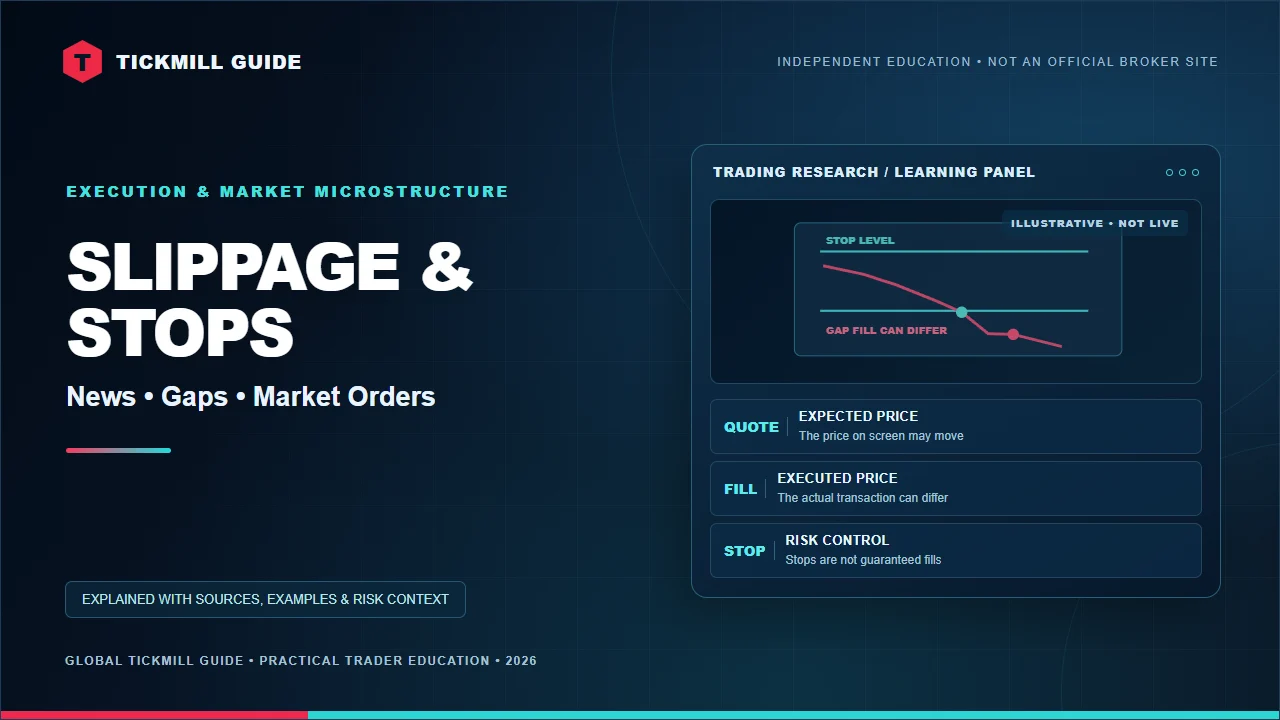
A stop-loss helps define trading risk, but it does not promise that your position will close at a particular price. During a major economic announcement, a weekend gap or thin liquidity, the price available when an order reaches the market can differ from the quote displayed moments earlier. Tickmill's European best-execution document explicitly warns about both favourable and adverse slippage and notes that it may affect several types of orders, including stops.
This explainer is for readers who want to understand order mechanics before building a strategy around small price targets. Execution policies are legal-entity-specific, so the cited European document should be treated as an example, not automatically the governing policy for a customer of Tickmill Ltd or any other group company.
What is slippage in a forex or CFD trade?
Slippage is the difference between an expected/requested price and the actual execution price. Suppose you intend to buy EUR/USD around 1.10000, but a sharp repricing means the available execution is 1.10020. The two-pip difference is adverse for that hypothetical buy order. If the fill is better than expected, slippage can also be positive. The direction depends on order type, market movement and execution conditions.
| Scenario | Expected | Actual | Interpretation |
|---|---|---|---|
| Buy during fast rise | 1.10000 | 1.10020 | 2 pips worse, illustrative |
| Buy during price improvement | 1.10000 | 1.09990 | 1 pip better, illustrative |
| Sell stop after a gap | 1.09900 | 1.09840 | 6 pips worse, illustrative |
These are invented examples for teaching the concept, not actual Tickmill fills. On a live account, the applicable product, quote precision, available liquidity, contract specification and account category all matter. A five-digit broker quote should not be confused with a conventional four-decimal pip.
How stop-loss execution differs from a guaranteed price
A normal stop-loss becomes executable when its trigger condition is met, but the resulting fill depends on available prices. When a market gaps past a stop level, there may be no opportunity to transact at that exact level. For example, if a long position carries a stop intended to limit a loss to $50, a gap can produce a realised loss greater than $50. This is why an arithmetic position-size model should include a scenario for price movement beyond the planned stop.
Tickmill's European summary of its best-interest and order-execution policy discusses slippage under illiquidity, volatility, market openings and news events. It lists order categories in which slippage may occur. That is a useful warning against interpreting platform graphics or stop lines as a contractual fixed-price promise.
What happens to spreads during news releases?
A spread reflects the gap between an available bid and ask. As liquidity providers reassess quotes during major data releases or market-open transitions, this gap may widen. An EA that buys or sells solely because a fixed technical price was crossed may enter at a very different effective cost from a calm-session backtest. The strategy can be especially vulnerable if the average target is only a few pips.
Consider a hypothetical scalper targeting four pips. A normal spread of 0.2 pip may leave room for the trade plan, whereas a two-pip spread during volatility consumes half the gross target even before commission and slippage. Those numbers are illustrative rather than Tickmill quotes. A high-frequency strategy should record executable spreads by time of day, not just the broker's minimum advertised spread.
Execution risk is not one number
Cost models need these three scenarios, alongside commissions, swap and conversion.
Market, limit and stop orders are different tools
A market order prioritises attempting execution at the current available price; a limit order specifies a price condition and may remain unfilled; a stop order can become an executable instruction after its trigger. These definitions do not remove account-specific restrictions or the risk that a broker's processing rules affect the final result. A “better” entry price from a limit order is no benefit if the order never participates in the move you expected.
A beginner should practise all three order types in a demo and then recognise the difference between simulated and live fills. Tickmill's FAQ explains that demo accounts may not experience slippage in the same way as real-money accounts. Use our demo account guide to structure those tests.
Why server location and VPS latency cannot eliminate slippage
A VPS may reduce network delay between your terminal and a broker's infrastructure. However, even a near-instant signal cannot force liquidity to exist at the intended price. Tickmill's VPS materials discuss low latency as an operational advantage, not a guarantee about how every order will be filled during a gap. An EA with a poorly chosen entry rule remains risky on the fastest possible server.
Read our VPS setup guide for practical monitoring and recovery steps. If the trade's expected edge disappears when allowing for one or two extra pips of cost, that fragility deserves attention before automating it.
Five checks before trading a scheduled announcement
- Know the actual release time and potential market liquidity window.
- Review both recent and worst-observed spreads for the symbol and session.
- Calculate the downside if a stop fills worse than planned.
- Check combined positions that could move together after the same news.
- Consider reducing size or not trading if the required execution assumptions are unrealistic.
Do not assume that waiting for a headline automatically makes a trade more informed. Markets respond to both the data and expectations already embedded in prices. A large initial candle can reverse before a manual order is confirmed. The absence of a trade may be the prudent outcome of a clear decision process.
How to analyse your actual execution quality
Maintain a record of the signal time, displayed quote, order submission time, fill price, spread, size, fees and market event. Classify fills as better or worse than expected, then compare those observations with time-of-day and volatility. A screenshot of a chart alone cannot prove a fill could have occurred at a particular historical price.
For a position where a hypothetical two-pip slip changes the expected outcome, record it explicitly in backtests and forward tests. Review a statistically meaningful set of trades rather than celebrating the handful that happened to receive positive slippage.
Frequently asked questions
Does a stop-loss guarantee my maximum loss?
No. Standard stops are subject to execution conditions and may slip during gaps or volatile markets. Any guaranteed-stop offering would need its own explicit terms.
Can slippage be favourable?
Yes. Tickmill's European execution policy discusses positive and negative slippage, although which orders are eligible and how price improvements are handled depends on execution rules.
Does faster internet solve the problem?
Better connectivity can reduce some avoidable delays but cannot eliminate market liquidity shortages or gaps. Test the actual execution process and risk exposure.
Official sources and scope
Reviewed October 2026: Tickmill Europe best-execution policy summary (PDF), demo versus live FAQ and VPS operating explanation. Actual binding terms depend on the entity and agreement for your account.
Check the details before you trade
Confirm the broker entity, account eligibility, latest fees, platform options and risk documents with Tickmill. We may earn a commission from a qualifying referral. This is not personalised investment advice.
Visit Tickmill through our affiliate link →Important: Leveraged trading can cause significant losses and is not appropriate for everyone. This independent site is not operated or endorsed by Tickmill. Read the Affiliate Disclosure and Risk Disclosure.


Comments
Have a question about this guide? Join the conversation below.
Post a Comment