Tickmill XAUUSD Gold Trading: Lot Size, Pip Value, Margin and Risk Examples
Editorial check: October 2026 · Independent education · Trading terms vary by legal entity and country.
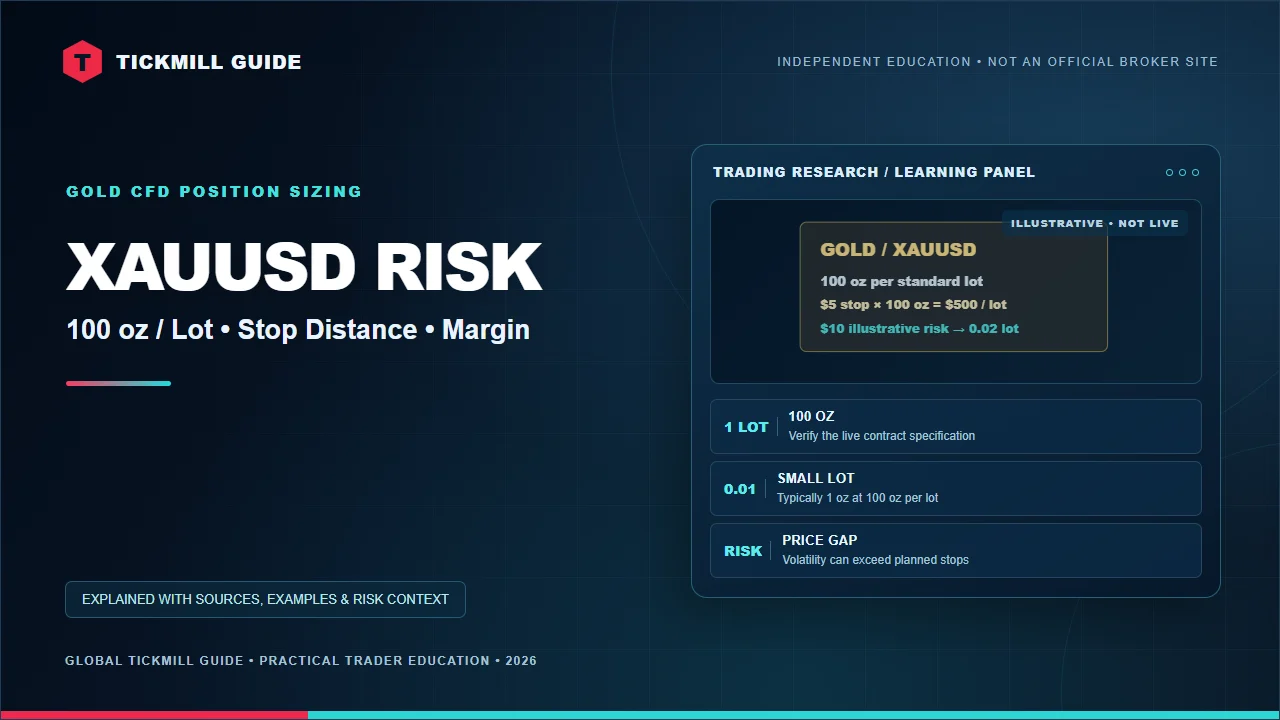
Gold can move quickly enough to make a position that looks small in lots unexpectedly large in dollars. At Tickmill, the published XAUUSD specification on the international instrument page identifies a contract size of 100 troy ounces per standard lot, with a minimum volume of 0.01 lot. That gives traders a useful starting point for the arithmetic, but not a reason to trade the maximum size their margin permits.
This guide focuses on sizing and execution, not predicting the next gold price. Instrument conditions, contract values, leverage and available markets may differ by Tickmill legal entity and account type. Verify the actual XAUUSD specification from your trading terminal before placing a real order.
What does one lot of XAUUSD represent?
If the contract is 100 ounces per standard lot, a one-dollar movement in gold changes the notional P&L by approximately $100 for a one-lot position, before spreads, commissions and conversion. The same $1 market move changes a 0.10-lot position by about $10 and a 0.01-lot position by about $1 under these assumptions. The instrument's tick size and account-currency conversion can change the displayed value in the terminal.
| Illustrative volume | Gold exposure at 100 oz/lot | P&L for a $1 gold move |
|---|---|---|
| 1.00 lot | 100 oz | Approximately $100 |
| 0.10 lot | 10 oz | Approximately $10 |
| 0.01 lot | 1 oz | Approximately $1 |
These figures assume a USD-denominated price quotation and ignore all costs. Do not treat forex pip-value rules as interchangeable with gold contract calculations. Some terminals display points or ticks in a way that can confuse a trader expecting a currency-pair pip to mean the same thing.
Calculate position size from a stop, not from available margin
Imagine a trader has $1,000 in account equity and has chosen an educational risk budget of 1%, or $10, for one hypothetical trade. If the intended stop is $5 away in the gold price and the standard lot represents 100 ounces, the arithmetic is: 10 ÷ (5 × 100) = 0.02 lots. This ignores commission, spread and adverse slippage, so the actual downside may exceed the budget.
The 1% figure is an illustration, not a universally suitable recommendation. A trader whose circumstances cannot tolerate a $10 loss may need a lower position size or no exposure at all. Stop orders do not guarantee execution at their requested level during gaps or volatile announcements.
One worked gold-risk calculation
Add transaction costs and a slippage allowance. This is an arithmetic example, not an entry signal.
How much margin does gold require?
Margin is the deposit required to support a position; it is not the amount of money the position can lose. Under a purely hypothetical example where gold trades at $2,500 per ounce, a one-lot contract represents about $250,000 in notional exposure. At 1:100 leverage, the simplified starting margin would be around $2,500. At 1:500 it would be about $500. Both positions still hold the same market exposure.
Do not use those figures as a Tickmill margin quote. The example price is deliberately hypothetical, and your assigned leverage may differ substantially from global marketing numbers. Tickmill's EU offering illustrates why: retail leverage ceilings for gold may be materially lower than the international offering. Check the contract specifications and platform margin calculator associated with the entity serving you.
Why spreads and execution matter for scalping gold
Gold's quoted bid-ask spread can widen when liquidity thins or a major data release approaches. A strategy targeting a relatively small price move may spend an outsized share of its gross target on spread and commission. A market order triggered during a rapid repricing event may also fill away from the quote you expected.
Before deciding that Tickmill's Raw or Classic account is “cheaper” for XAUUSD, collect actual session-specific spreads and read the instrument's fee structure. Do not assume a forex round-turn commission schedule automatically applies to precious metals. Our real trading-cost guide explains the separate components.
Three scenarios worth stress testing
First, assume the spread at entry is several times wider than your usual observation. Second, imagine a $10 gap that moves past the stop you planned. Third, consider two open positions that both lose money during the same broad dollar move. Calculate the combined decline in account equity under all three conditions. It is easy to overlook correlation between gold and other positions even if the symbols are different.
A chart may suggest a perfect technical stop, but the stop distance must also produce a lot size consistent with acceptable loss, exchange-rate conversion and your broker's minimum volume. If the calculated size is smaller than the platform supports, it may be better to pass on the trade rather than round risk upward.
Compare the result with a calculator
The ForexSignal24 broker tools may help you think through pip and position-size assumptions, but ensure that any calculator you use supports the XAUUSD contract size, quote precision and currency conversion relevant to your account. An apparently precise answer based on a forex-pair assumption can be wrong for a metal.
Record the exact contract fields displayed in MetaTrader: volume step, contract size, tick size, tick value and margin requirements. For general limits on leverage and stop-out, see our margin survival guide.
- Confirm XAUUSD contract size and the correct account currency.
- Translate the stop distance into actual account-currency loss.
- Add spread, commission and potential slippage.
- Check the required margin, current equity and total correlated exposure.
- Understand the impact of a news release or market gap before trading.
Frequently asked questions
Does 0.01 lot of XAUUSD mean one ounce?
At a 100-ounce standard contract, yes: 0.01 × 100 = one ounce of CFD exposure. Confirm the actual contract shown by your entity and platform.
Can gold lose more than the posted margin?
Yes, a price move can produce losses materially larger than the initial margin on a leveraged position. Any applicable negative-balance protection has its own terms and does not remove the danger of losing deposited capital.
Is a tighter minimum spread a guarantee of cheap gold trading?
No. Minimum quotations are not typical realised spreads, and the total result depends on commission, execution, holding time and conversion.
Official source and methodology
Reviewed October 2026: Tickmill XAUUSD contract specification, account and platform FAQ, and entity-specific rules. Values in worked examples are hypothetical and not market quotations.
Check the details before you trade
Confirm the broker entity, account eligibility, latest fees, platform options and risk documents with Tickmill. We may earn a commission from a qualifying referral. This is not personalised investment advice.
Visit Tickmill through our affiliate link →Important: Leveraged trading can cause significant losses and is not appropriate for everyone. This independent site is not operated or endorsed by Tickmill. Read the Affiliate Disclosure and Risk Disclosure.


Comments
Have a question about this guide? Join the conversation below.
Post a Comment